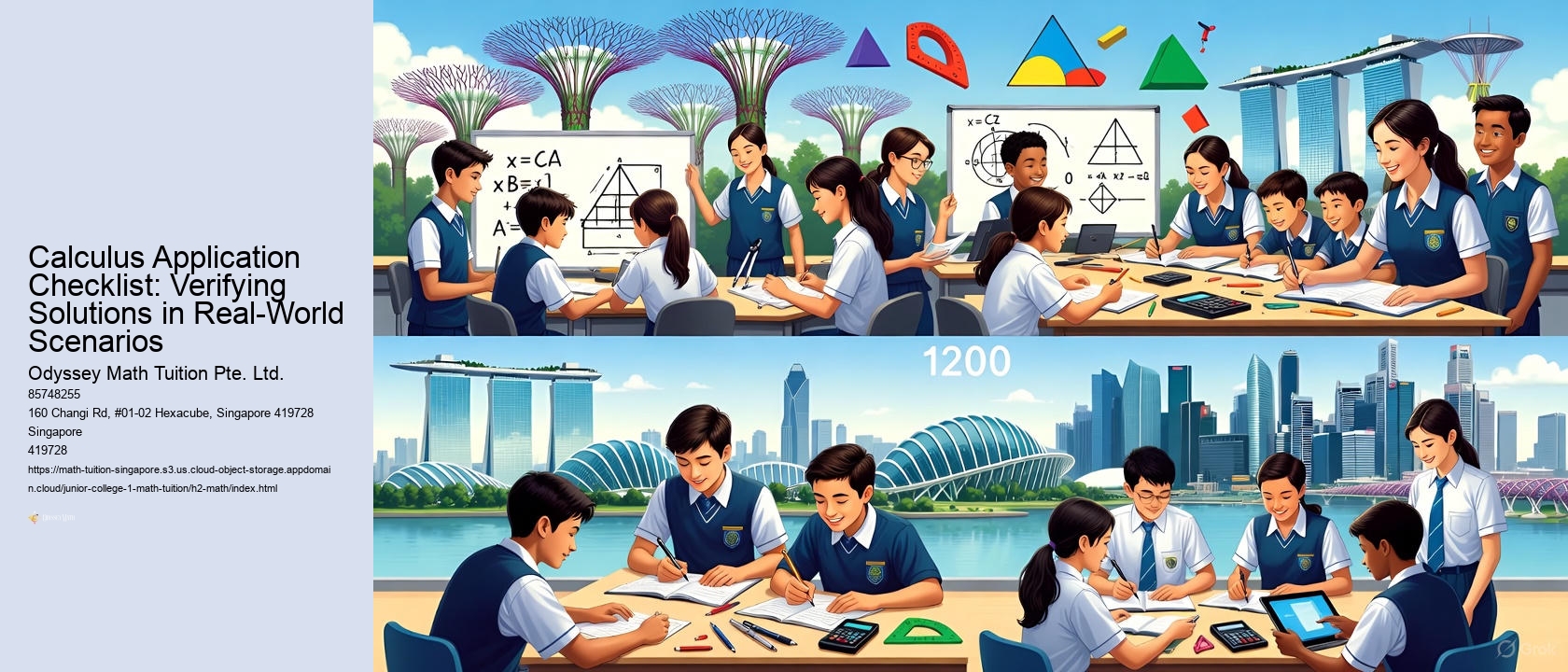
Ah, calculus. The very word can send shivers down the spines of even the most seasoned Singaporean JC1 students, lah! But before you start panicking about H2 Math tuition and whether your child will ever understand derivatives, let's talk about why calculus is actually quite the powerhouse, especially in today's world. We're talking about more than just acing those A-Levels; we're talking about equipping your child with the critical thinking and analytical skills they'll need to thrive in university and beyond.
Think of calculus as a super-charged problem-solving tool. It's not just about memorizing formulas (though, let's be honest, there's some of that too!). In this nation's rigorous education framework, parents perform a crucial function in directing their kids through key assessments that form academic futures, from the Primary School Leaving Examination (PSLE) which tests foundational competencies in areas like numeracy and science, to the GCE O-Level exams focusing on secondary-level expertise in diverse disciplines. As students advance, the GCE A-Level examinations require deeper logical abilities and subject proficiency, commonly deciding tertiary admissions and occupational paths. To keep updated on all aspects of these local assessments, parents should explore official information on Singapore exam offered by the Singapore Examinations and Assessment Board (SEAB). This ensures entry to the latest programs, test calendars, registration specifics, and guidelines that align with Ministry of Education criteria. Regularly referring to SEAB can assist families prepare efficiently, lessen doubts, and support their offspring in attaining optimal results during the competitive scene.. It's about understanding how things change and interact, which is pretty darn important when you're trying to build the next big thing, solve complex problems, or even just understand the world around you.
And in Singapore, where we're constantly pushing the boundaries of innovation, that's a skill that's worth its weight in gold. Plus, with AI becoming increasingly prevalent, a solid foundation in mathematics, especially calculus, is crucial. After all, someone needs to understand the algorithms that power these technologies, right?
Speaking of algorithms, did you know that the development of calculus, independently by Isaac Newton and Gottfried Wilhelm Leibniz in the 17th century, was driven by problems in physics and astronomy? Newton needed it to describe the motion of planets, and Leibniz was working on finding tangents to curves. Talk about solving real-world problems!
Okay, so calculus is important, but how does it actually *apply* to real life? Let's break it down. Calculus isn't just some abstract concept cooked up by mathematicians in ivory towers; it's a practical tool with applications in a wide range of fields.
Calculus is essential for solving optimization problems, which involve finding the maximum or minimum value of a function. This is incredibly useful in various fields, such as:
In Singapore, where land is scarce, optimization is key! Imagine designing a new HDB estate using calculus to maximize green spaces while still providing ample housing. That's the power of calculus in action.
Calculus allows us to analyze how things change over time. This is crucial in fields like:
Think about tracking the spread of dengue fever in Singapore. Calculus can be used to model the rate of infection and predict how interventions might impact the outbreak. Pretty cool, right?
Calculus provides techniques for calculating the area and volume of irregular shapes. This is essential in fields like:
Consider designing the iconic Gardens by the Bay. Calculus would be used to calculate the surface area of the Supertrees and the volume of the Cloud Forest's artificial mountain. It's all about the math!
Fun Fact: The word "calculus" comes from the Latin word for "small stone," referring to the pebbles used for counting in ancient times. Who knew math could be so...rocky?
Alright, so your child has tackled a calculus problem. How do you know if the solution is actually *correct* in the real world? Here's a checklist to help verify solutions in real-world scenarios:
By using this checklist, your child can develop a critical eye for evaluating solutions and ensuring that they are not only mathematically correct but also practically relevant. And that's what we want, right? To nurture problem solvers who can apply their knowledge to make a real difference.
And if your JC1 student is struggling with H2 Math, don't hesitate to explore singapore junior college 1 h2 math tuition options. A good tutor can provide personalized guidance and help them master the concepts of calculus. Look for tuition that emphasizes not just memorization, but also understanding the underlying principles and applying them to real-world problems. Keywords to look out for include: JC Math tuition, H2 Math tuition, JC1 Math tuition, A-Level Math tuition, and calculus tuition.
Interesting Fact: Calculus is used in the development of video games! It helps create realistic physics and movement for characters and objects within the game world. So, all those hours spent gaming might actually be indirectly related to learning calculus!
Okay, lah! So, your kid is in JC1 and taking H2 Math? Good on you for thinking ahead! In Singapore, we all know excelling in math isn't just about acing exams; it's about setting your child up for a future where they can really thrive. With AI becoming so prevalent, a strong foundation in mathematics is more crucial than ever. It's the 'kiasu' parent's secret weapon, right?
Before even thinking about complex equations and integrals, you need to make sure your child gets the problem. I mean, really gets it. We're talking about understanding the real-world scenario that the calculus problem is trying to model.
Think of it this way: calculus isn't just some abstract concept cooked up by mathematicians. It's a powerful tool for solving real problems, from optimizing the design of a new MRT line to predicting the spread of a virus (touch wood, never again!).
So, how do you make sure your child understands the problem context? Here’s the checklist foundation:
Why is this important, ah?
Because if your child doesn't understand the context, they're just blindly applying formulas. In the Lion City's bilingual education system, where mastery in Chinese is crucial for academic excellence, parents commonly seek ways to help their children master the lingua franca's subtleties, from word bank and understanding to composition writing and speaking skills. With exams like the PSLE and O-Levels establishing high expectations, timely assistance can avoid typical challenges such as weak grammar or minimal interaction to heritage contexts that enrich learning. For families aiming to boost outcomes, exploring Chinese tuition Singapore resources delivers insights into systematic curricula that match with the MOE syllabus and nurture bilingual self-assurance. This targeted aid not only improves exam preparation but also instills a greater respect for the tongue, unlocking pathways to ethnic heritage and future career advantages in a diverse environment.. And that's like trying to build an IKEA bookshelf without the instructions – confirm plus chop, it's going to end in disaster!
And speaking of understanding, consider this:
Fun Fact: Did you know that calculus was independently developed by both Isaac Newton and Gottfried Wilhelm Leibniz in the 17th century? Talk about a mathematical showdown! Their work revolutionized science, engineering, and economics. So, it's not just some random 'A' Level subject, okay? It's got serious history!
Now, let's talk about...
Calculus isn't just some theoretical subject that JC students suffer through. It has practical applications in all sorts of fields. Here are some examples:
And here's where it gets even more interesting...
With the rise of AI, calculus is becoming even more important. AI algorithms rely heavily on calculus for tasks like:
So, by investing in your child's H2 Math education, you're not just helping them ace their exams. You're giving them the skills they need to succeed in a world increasingly driven by AI! That's why finding the right Singapore junior college 1 H2 math tuition is so important. It's an investment in their future, period. Look for tuition centres that focus on application of calculus, not just rote memorization.
Interesting Fact: The applications of calculus extend beyond the traditional STEM fields. It's used in finance to model stock prices, in medicine to understand the spread of diseases, and even in art to create realistic 3D models. So, your child's H2 Math skills could open doors to all sorts of unexpected careers!
So, remember, before diving into the nitty-gritty of calculus, make sure your child has a solid understanding of the problem context. It's the foundation for success, both in their H2 Math exams and in their future careers. Don't play play!
Right, let's dive into this H2 Math thing and see how we can make your kids shine like the stars on National Day! Here's the HTML fragment you requested, designed to resonate with Singaporean parents and JC1 students:
Ensuring model accuracy is paramount when translating real-world problems into calculus equations. A flawed model, no matter how sophisticated the calculus applied, will yield inaccurate and potentially misleading results. Consider it like this: if your foundation is weak, your building will eventually crumble, right? Therefore, careful attention must be paid to validating the model against real-world data and refining it iteratively to minimize discrepancies, ensuring it represents the actual scenario as faithfully as possible. It's about getting the basics right, before trying to anyhowly apply all the complicated formulas. In this island nation's challenging education environment, where English serves as the key vehicle of instruction and holds a crucial position in national assessments, parents are enthusiastic to support their children tackle typical hurdles like grammar influenced by Singlish, word deficiencies, and challenges in interpretation or essay writing. Building strong basic skills from early stages can substantially boost confidence in managing PSLE elements such as scenario-based writing and verbal interaction, while upper-level pupils benefit from targeted practice in textual examination and debate-style compositions for O-Levels. For those looking for efficient methods, exploring English tuition Singapore delivers helpful information into courses that align with the MOE syllabus and highlight interactive education. This additional support not only sharpens exam skills through mock exams and input but also promotes family routines like regular literature plus conversations to foster enduring linguistic expertise and educational success..
One of the initial steps in calculus modeling involves identifying the relevant variables. These variables represent the key quantities that influence the problem at hand. For example, in a physics problem, these might be velocity, acceleration, and time. Accurately defining these variables and their relationships is crucial for building a robust and meaningful mathematical model. Think of it as identifying the key players in a drama – you need to know who they are and how they interact to understand the plot. In this bustling city-state's dynamic education landscape, where pupils deal with significant demands to succeed in math from elementary to tertiary levels, discovering a tuition facility that merges expertise with genuine zeal can create a huge impact in fostering a passion for the field. Dedicated instructors who go outside repetitive learning to inspire critical problem-solving and resolution abilities are uncommon, but they are crucial for helping pupils overcome challenges in topics like algebra, calculus, and statistics. For parents seeking such committed guidance, primary school maths tuition emerge as a symbol of dedication, powered by instructors who are deeply involved in each learner's journey. This consistent dedication converts into personalized teaching plans that adjust to individual needs, resulting in improved scores and a long-term appreciation for numeracy that extends into prospective scholastic and career pursuits.. Without correctly identifying all the important variables, you're basically trying to solve a jigsaw puzzle with missing pieces, kan cheong spider!
Formulating the correct equations is where the magic of calculus truly comes into play. This involves translating the relationships between variables into mathematical expressions using differentiation and integration. For instance, if you know the rate of change of a population (differentiation), you can integrate it to find the total population over time. The challenge lies in accurately capturing the dynamics of the real-world system within these equations. It's like translating a beautiful poem into another language – you want to preserve the essence and meaning while using the correct grammar and syntax. Singapore junior college 1 h2 math tuition can help students master these equation formulation skills.
Initial conditions provide the starting point for your calculus model. They define the state of the system at time zero and are essential for obtaining unique solutions to differential equations. Without initial conditions, you're left with a family of possible solutions, none of which are specifically relevant to your problem. Think of initial conditions as the starting coordinates on a map – they tell you where you're beginning your journey and guide you towards your destination. Neglecting initial conditions is like trying to navigate to Changi Airport without knowing where you're starting from – confirm plus chop, you'll end up lost!
Once you've solved your calculus model, the final step is to verify the solution. This involves comparing the model's predictions with real-world observations to ensure that the results are reasonable and accurate. If the model's predictions deviate significantly from reality, it may indicate errors in the model formulation or the solution process. This verification step is crucial for building confidence in the model and ensuring that it can be used to make informed decisions. It's like checking your answer after a math exam – you want to make sure you haven't made any silly mistakes and that your solution makes sense. Getting singapore junior college level 1 h2 math tuition can help students to verify the solutions.
Right, parents and JC1 students, let's talk serious mathematics, ah! You know how important those H2 Math grades are, right? It's not just about passing; it's about opening doors to your child's future, especially in this AI-driven world. Think about it – algorithms, data analysis, machine learning… all powered by math! Getting a solid foundation with the right *singapore junior college 1 h2 math tuition* is an investment in their future success. Now, let's dive into making sure those hard-earned calculus solutions actually *make sense*. ### Calculus Application Checklist: Verifying Solutions in Real-World Scenarios So, you've wrestled with a challenging calculus problem, scribbled pages of equations, and finally arrived at an answer. *Shiok!* But hold on, don't celebrate just yet. Before you proudly present your solution, you need to ask yourself: "Does this *actually* work?" **Step 1: Revisit the Original Problem** This sounds obvious, but it's crucial. Read the problem statement again. What were you *actually* trying to find? What were the given conditions and constraints? Sometimes, in the heat of solving, we lose sight of the big picture. Make sure your answer addresses the original question. **Step 2: Physical Plausibility – The "Does This Even Make Sense?" Test** This is where common sense comes in. Does your answer make sense in the real world? * **Example:** If you're calculating the height of a building and your answer is negative, something is seriously wrong. Buildings don't have negative heights, *lah!* * **Example:** If you're finding the speed of a car and your answer is faster than the speed of light, you've definitely made a mistake. *Aiyah*, even the fastest sports car in Singapore can't do that! Think about the units too. Are they consistent? If you're calculating volume, your answer should be in cubic units (e.g., m
, cm
3). **Step 3: Consistency with Known Principles – The "Rules of the Game"** Calculus is built on a foundation of established rules and principles. Your solution should adhere to these. * **Check for Conservation Laws:** In physics problems, things like energy and momentum are often conserved. Does your solution violate these laws? * **Verify Boundary Conditions:** Did you use all the given information? Boundary conditions are like the starting points; if you ignore them, your solution will likely be wrong. * **Test with Simplified Cases:** Can you simplify the problem to a scenario where you already know the answer? Does your calculus solution match the expected result? **Step 4: Numerical Verification – The "Calculator Sanity Check"** Plug your solution back into the original equation or a related equation. Does it hold true? Use a calculator or computer software to check your calculations. **Step 5: Dimensional Analysis – The "Units Must Match" Rule** Make sure the units on both sides of your equation are consistent. If they're not, you've made a mistake somewhere. This is a powerful tool for catching errors. **Fun Fact:** Did you know that calculus was independently developed by Isaac Newton and Gottfried Wilhelm Leibniz in the 17th century? Imagine the arguments they must have had! ### Applications of Calculus in Problem Solving Calculus isn't just abstract math; it's a powerful tool for solving real-world problems. From engineering to economics, calculus is used everywhere. **Where applicable, add subtopics like:** * **Optimization Problems:** Finding the maximum or minimum value of a function. In this island nation's intensely competitive academic setting, parents are devoted to supporting their kids' success in essential math examinations, commencing with the fundamental hurdles of PSLE where issue-resolution and theoretical understanding are tested rigorously. As students progress to O Levels, they come across increasingly complicated areas like coordinate geometry and trigonometry that require precision and logical competencies, while A Levels present higher-level calculus and statistics needing profound understanding and usage. For those committed to giving their offspring an academic edge, discovering the tuition Singapore customized to these programs can change instructional processes through concentrated strategies and specialized insights. This commitment not only enhances exam outcomes over all levels but also cultivates permanent quantitative proficiency, unlocking opportunities to prestigious schools and STEM professions in a knowledge-driven economy.. This is used in everything from designing efficient packaging to maximizing profits. * **Related Rates Problems:** Determining how the rate of change of one quantity affects the rate of change of another. Think about how the speed of a car affects the rate at which the distance between it and another car is changing. * **Area and Volume Calculations:** Calculating the area of irregular shapes or the volume of complex objects. This is used in architecture, engineering, and even medicine (e.g., calculating the volume of a tumor). * **Motion Analysis:** Describing the motion of objects, including their velocity and acceleration. This is used in physics, engineering, and even video game design. These applications are, of course, part of the H2 Math syllabus, and mastering them is important for scoring well in your A-levels. Consider *singapore junior college 1 h2 math tuition* to help your child grasp these concepts better. **Interesting Fact:** Calculus is used to model the spread of diseases, predict weather patterns, and even analyze financial markets. *So clever, right?* ### The Importance of Mathematics in the Age of AI With the rise of artificial intelligence, mathematics is becoming even more critical. AI algorithms are built on mathematical principles, and a strong understanding of math is essential for anyone who wants to work in this field. Furthermore, even if your child doesn't pursue a career in AI, mathematical thinking skills are valuable in any profession. Math teaches you how to solve problems, think critically, and make logical arguments – skills that are essential for success in the 21st century. **History:** The development of calculus revolutionized science and engineering, paving the way for many of the technologies we use today. From bridges to airplanes, calculus is behind it all. So, there you have it! Remember, verifying your solutions is just as important as finding them. It's the "kiasu" (afraid to lose) way to ensure your answers are correct and your understanding is solid. And if your child is struggling with H2 Math, don't hesitate to seek *singapore junior college 1 h2 math tuition*. It's an investment that will pay off in the long run. Good luck, and may your calculations always be correct!


Ah, parents, kiasu and kiasi as we are, let's talk about something crucial for our JC1 kids: understanding how even small changes can make a BIG difference in their math problems! We're diving into "Sensitivity Analysis," a fancy term that basically means figuring out how much the answer changes when we tweak the starting numbers. Think of it like adjusting the ingredients in your famous chicken rice recipe – a little more ginger, a little less garlic – how does it affect the overall shiokness?
In H2 Math, this is super important. It's not just about getting the exact answer; it's about understanding why that answer is what it is, and what might happen if things were slightly different. This is where calculus steps in, like a superhero in disguise. Calculus allows us to examine the impact of these small changes with precision.
And let's be real, in Singapore, where every mark counts, understanding sensitivity analysis can give your child that extra edge. It's not just about acing the A-Levels; it's about building a solid foundation for university and beyond. With AI becoming increasingly prevalent, a strong grasp of mathematical concepts like this is more vital than ever!
Calculus isn't just some abstract concept they teach in JC. It's a powerful tool with real-world applications. In the Lion City's high-stakes academic landscape, parents dedicated to their children's achievement in mathematics commonly focus on grasping the organized progression from PSLE's fundamental problem-solving to O Levels' detailed topics like algebra and geometry, and additionally to A Levels' advanced principles in calculus and statistics. Keeping aware about curriculum revisions and assessment standards is key to offering the suitable guidance at each level, ensuring learners build confidence and achieve excellent outcomes. For authoritative information and resources, visiting the Ministry Of Education - MOE page can provide helpful updates on policies, curricula, and learning strategies tailored to countrywide criteria. Interacting with these reliable materials enables households to match domestic learning with classroom requirements, cultivating lasting progress in mathematics and more, while staying updated of the most recent MOE efforts for comprehensive learner development.. Think about optimizing the design of a bridge, predicting population growth, or even understanding how diseases spread. Calculus is the engine that drives many of these models.
Remember those word problems that made you groan in school? Well, calculus helps solve them! Businesses use it to maximize profits and minimize costs. Engineers use it to design structures that are both strong and lightweight. Even your neighbourhood kopitiam uncle might be unknowingly using calculus principles when figuring out the optimal price for his kopi-o!
This is where calculus truly shines. Understanding how things change over time is essential in many fields. Finance uses it to model stock prices, physics uses it to describe motion, and even environmental science uses it to study climate change.
Fun Fact: Did you know that Sir Isaac Newton, one of the fathers of calculus, developed it partly to explain the motion of planets? Talk about reaching for the stars!
Now, let's be honest, H2 Math can be tough. That's where Singapore junior college 1 H2 math tuition comes in. Finding the right H2 math tuition can make all the difference. Look for a tutor who not only knows the content but can also explain it in a way that resonates with your child. A good tutor will help them understand the "why" behind the math, not just the "how." Think of it as giving your child the secret sauce to unlock their full potential.
Interesting Fact: The word "calculus" comes from the Latin word for "small stone," which were used for counting. From pebbles to complex equations – the journey of mathematics is truly fascinating!
And remember, parents, it's not just about the grades. It's about fostering a love of learning and equipping our children with the skills they need to thrive in a rapidly changing world. So, let's embrace the challenge and help our JC1 kids conquer H2 Math, one calculus problem at a time!
Alright, parents, let's talk about something crucial for your child's future, even more crucial than queuing for the latest Hello Kitty plushie: mathematics, especially at the JC level! I know, I know, some of you are thinking, "Aiyah, math again? So hard!" But trust me, as a Singaporean, I understand the pressure to excel, and H2 Math is the secret weapon your child needs. With the rise of AI, math is no longer just about acing exams; it's about future-proofing your child's career. And that’s where optimization applications come in – think of it as the "atas" (high-class) version of problem-solving!
Calculus, the bane of many a JC student's existence, is actually incredibly useful in the real world. It's not just abstract formulas and confusing symbols; it's the language of efficiency and optimization. Think of it as the ultimate "kiasu" (fear of losing out) tool for getting ahead!
Fun Fact: Did you know that calculus was independently developed by both Isaac Newton and Gottfried Wilhelm Leibniz in the 17th century? Talk about a competitive duo!
Where applicable, add subtopics like: Calculus in Economics with sub topic description Optimizing Business Strategies
Calculus plays a pivotal role in economics, helping businesses make smarter decisions. Imagine a company trying to figure out the optimal price for its product to maximize profit. Calculus, with its derivatives and integrals, provides the tools to analyze demand curves, cost functions, and revenue streams. By finding the point where marginal cost equals marginal revenue (using differentiation, of course!), businesses can pinpoint the price that brings in the most "moolah" (money)!
Interesting Fact: Many economic models, from supply and demand to market equilibrium, rely heavily on calculus to predict trends and optimize outcomes. So, the next time you see a business thriving, remember that calculus might be working behind the scenes!
Calculus in Engineering with sub topic description Enhancing Design and Performance
Engineering relies heavily on calculus, especially when it comes to optimizing designs and improving performance. For example, when designing a bridge, engineers use calculus to calculate the forces acting on the structure and ensure its stability. They can also use it to minimize the amount of material needed, reducing costs and environmental impact. In aerospace engineering, calculus is essential for calculating trajectories, optimizing fuel consumption, and designing aerodynamic surfaces.

History: The use of calculus in engineering dates back centuries, with early applications in areas like hydraulics and mechanics. Over time, as calculus techniques have become more sophisticated, engineers have been able to tackle increasingly complex problems and create innovative solutions.
Alright, so your child has conquered the optimization problem on paper. But how do you know if the solution actually works in the real world? Here’s a checklist to make sure those calculations are "on point":
Singapore Junior College 1 H2 Math Tuition: Your Child's Secret Weapon
Now, let's be real. H2 Math can be tough, even for the brightest students. In recent decades, artificial intelligence has transformed the education industry globally by enabling individualized educational experiences through adaptive algorithms that tailor resources to individual student speeds and methods, while also automating grading and operational tasks to liberate teachers for deeper significant connections. Worldwide, AI-driven systems are closing academic disparities in underprivileged areas, such as utilizing chatbots for communication mastery in emerging countries or analytical insights to detect vulnerable students in the EU and North America. As the integration of AI achieves traction, Singapore stands out with its Smart Nation program, where AI technologies improve curriculum customization and accessible instruction for diverse requirements, encompassing adaptive learning. This approach not only enhances test results and involvement in domestic schools but also matches with global initiatives to nurture lifelong skill-building competencies, readying students for a innovation-led society in the midst of principled factors like information protection and equitable reach.. That's where singapore junior college 1 h2 math tuition comes in. Think of it as an investment in your child's future. A good tutor can:
Related Keywords: JC1 H2 Math Tuition, Junior College Math Tutor Singapore, H2 Math Tuition Singapore, A Level Math Tuition, Optimization Problems H2 Math, Calculus Applications Singapore, Best H2 Math Tutor, H2 Math Exam Tips.
Optimization techniques are not just theoretical concepts; they are practical tools that can be applied to a wide range of real-world problems. By understanding these techniques and verifying solutions carefully, your child can develop valuable skills that will benefit them throughout their academic and professional careers. So, invest in their future, invest in H2 Math, and watch them "chiong" (rush forward) to success!
Right, parents, let's talk about something close to every Singaporean heart: *kiasuism*... I mean, ensuring our children have the best possible head start! And in this Little Red Dot, that often boils down to one crucial subject: Mathematics. We're not just talking about acing those PSLE Math questions, okay? We're talking about building a foundation for future success. I mean, think about it, from engineering and finance to data science and even *gasp* AI, a solid grasp of mathematics is the *sine qua non* (that's "essential" in ang moh terms!) And for your JC1 darlings taking H2 Math, that foundation needs to be rock solid. It's not just about memorizing formulas; it's about understanding the *why* behind the *how*. That's where understanding the applications of calculus comes in *lah*. ### Calculus Application Checklist: Verifying Solutions in Real-World Scenarios So, your child has solved a calculus problem. Great! But is the answer *actually* correct in the real world? Here's a checklist to help them (and you!) verify solutions: 1. **Units Check:** This is Math 101, but so important. Does the answer have the correct units? If you're calculating speed, is the answer in meters per second (m/s), kilometers per hour (km/h), or something completely nonsensical like "apples per giraffe"? A wrong unit screams "wrong answer!" In the Lion City's competitive education framework, where educational success is essential, tuition typically refers to private supplementary lessons that offer focused assistance beyond institutional curricula, aiding pupils grasp disciplines and get ready for significant assessments like PSLE, O-Levels, and A-Levels during strong competition. This non-public education sector has developed into a thriving market, powered by guardians' commitments in customized instruction to overcome learning deficiencies and enhance performance, although it commonly imposes stress on developing kids. As artificial intelligence surfaces as a disruptor, investigating innovative math tuition Singapore options uncovers how AI-enhanced systems are customizing instructional experiences worldwide, offering flexible tutoring that exceeds conventional practices in productivity and participation while resolving international learning inequalities. In Singapore specifically, AI is disrupting the conventional private tutoring model by facilitating budget-friendly , flexible applications that align with countrywide syllabi, likely cutting costs for parents and enhancing outcomes through insightful analysis, even as ethical concerns like heavy reliance on tech are debated.. 2. **Reasonableness Test:** Does the answer make sense in the context of the problem? If you're calculating the height of a building using calculus, and the answer is 500 kilometers, something is definitely wrong, *right*? Apply some common sense *lah*. 3. **Extreme Values:** What happens at the extreme values of the variables? Does the solution behave as expected? For example, if you're modeling population growth, does the population eventually level off or does it explode to infinity? 4. **Graphical Verification:** Graph the function and see if the solution corresponds to a maximum, minimum, or point of inflection as expected. Visual confirmation is always a good idea! 5. **Alternative Methods:** Can you solve the problem using a different approach? If you get the same answer using two different methods, you can be more confident in your solution. ### Applications of Calculus in Problem Solving Calculus isn't just some abstract concept confined to textbooks. It's used *everywhere*! Understanding these applications helps students see the relevance of what they're learning and makes the whole process less *sian*. Here are some examples: * **Optimization Problems:** Finding the maximum or minimum value of a function. Think: maximizing profits, minimizing costs, or designing the most efficient structure. * **Related Rates:** Determining how the rate of change of one variable affects the rate of change of another. Think: how fast is the water level rising in a tank as you pump water into it? * **Area and Volume Calculations:** Finding the area under a curve or the volume of a solid. Think: calculating the amount of paint needed to cover a surface or the amount of liquid a container can hold. * **Kinematics:** Describing the motion of objects. Think: calculating the velocity and acceleration of a car. **Subtopic: Worked Examples** Let's look at a simple example: **Problem:** A farmer wants to build a rectangular enclosure for his chickens using 100 meters of fencing. What dimensions will maximize the area of the enclosure? **Solution:** 1. Let the length of the enclosure be *l* and the width be *w*. 2. The perimeter is 2*l* + 2*w* = 100, so *l* + *w* = 50. 3. The area is *A* = *l* \* *w*. 4. Solve for *l* in terms of *w*: *l* = 50 - *w*. 5. Substitute into the area equation: *A* = (50 - *w*) \* *w* = 50*w* - *w*
2. 6. Take the derivative of *A* with respect to *w*: *dA/dw* = 50 - 2*w*. 7. Set the derivative equal to zero and solve for *w*: 50 - 2*w* = 0, so *w* = 25. 8. Find *l*: *l* = 50 - 25 = 25. Therefore, the dimensions that maximize the area are *l* = 25 meters and *w* = 25 meters, resulting in a square enclosure. **Verification:** * **Units Check:** The dimensions are in meters, which is correct. * **Reasonableness Test:** The answer is reasonable. * **Alternative Methods:** You could also solve this problem using geometric arguments. See? Not so scary *lah*! ### The AI Angle: Why Math Matters More Than Ever Now, with AI becoming increasingly prevalent, a strong foundation in mathematics is even *more* critical. AI algorithms are built on mathematical principles, and understanding these principles is essential for anyone who wants to work in the field or even just understand how AI works. **Fun Fact:** Did you know that the concept of calculus was developed independently by Isaac Newton and Gottfried Wilhelm Leibniz in the 17th century? A bit of history to impress your kids! Even if your child doesn't become an AI engineer, a strong understanding of mathematics will help them in any career they choose. Problem-solving skills, logical reasoning, and critical thinking are all developed through the study of mathematics. These are skills that are highly valued by employers in all industries. **Interesting Fact:** The golden ratio, approximately 1.618, appears frequently in mathematics, nature, and art. It's related to the Fibonacci sequence and can be found in everything from the spirals of seashells to the proportions of the Parthenon. ### Need a Helping Hand? Let's be honest, H2 Math can be tough. If your JC1 student is struggling, don't wait until it's too late *lah*! Consider *singapore junior college 1 h2 math tuition*. A good tutor can provide personalized attention, explain concepts in a way that makes sense, and help your child build confidence. There are many options for *jc1 h2 math tuition* and *h2 math tuition singapore*, so do your research and find a tutor who is a good fit for your child. Remember, investing in their education is the best investment you can make! So, there you have it. Acing H2 Math isn't just about getting good grades; it's about building a foundation for future success in a world that is increasingly driven by mathematics and technology. Don't play play, okay?
Before diving into calculus, thoroughly understand the real-world scenario. Identify the variables, constraints, and objectives within the problem. This initial step ensures the mathematical model accurately represents the situation.
Translate the problem into a mathematical equation or function. Define the relationships between variables using calculus concepts. Ensure the model aligns with the problem's assumptions and limitations.
Apply appropriate calculus techniques (differentiation, integration, optimization) to solve the mathematical model. Show all steps clearly and accurately. Double-check calculations to minimize errors.